Reasons Why More Homeowners Are Adding Landscape Lighting to Their Backyard
The reason it caught on is not aesthetics. It is that LED made it cheap to run and cheap to keep.
September 10, 2026 · 4 min read
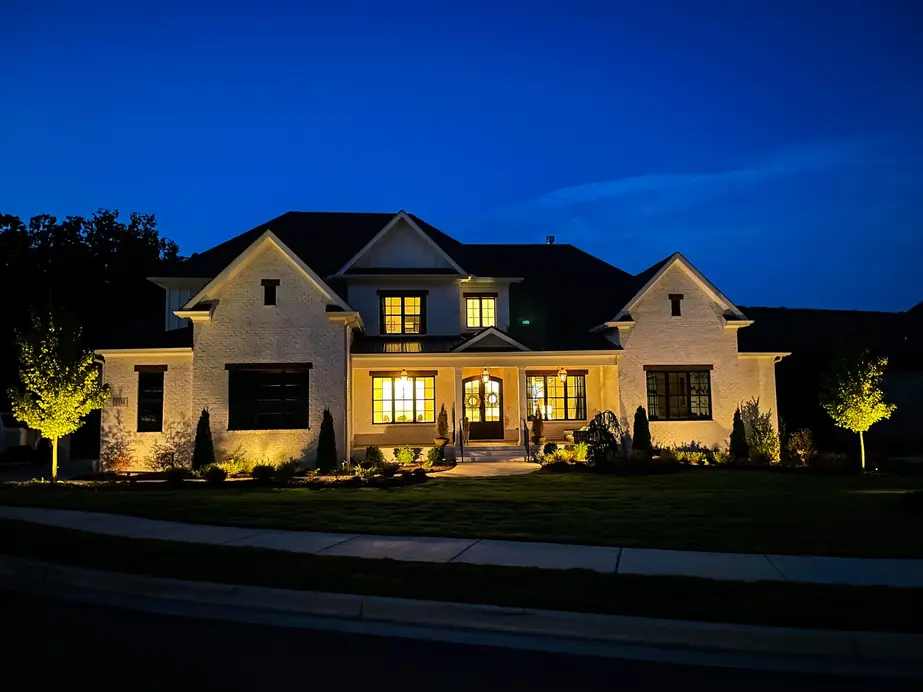
Landscape lighting used to be a luxury item, and for a straightforward reason: the old halogen systems were expensive to run and their lamps kept failing. A yard full of buried fittings that need replacing every couple of seasons is a commitment, not a feature.
LED changed the economics, and that is most of the story behind why so many more Huntsville backyards now have it.
It costs very little to run
Running cost is a fraction of what the systems it replaced consumed. That single change moved outdoor lighting from a thing you switched on for guests to a thing that simply runs every evening, which is what makes it feel worth having.
There is a second effect underground. LED runs cool and draws little current, which keeps wiring smaller and connections less stressed across a long buried run. The lamps also last long enough that a properly installed system is not a maintenance liability the way its predecessors were.
It extends the part of the day you use the garden
This is the reason people give afterwards, even when it was not the reason they called. A patio that becomes unusable at dusk is a patio you use for a few months a year. Lit properly, the same space stays in use through the evening, which is when most people are actually home.
It also changes what you see from indoors. An unlit yard at night is a black rectangle in the window. A lit one gives you back the view you paid for when you bought the house.
Safety, which is the unglamorous half
Steps, level changes, the edge of a drive and the path from the car to the door are all places people trip in the dark. Lighting them is not decorative.
A house that is visibly occupied and lit is also a less appealing target than one that disappears at sunset, which is a benefit most homeowners mention only after they have it.
Where light goes in a yard
There are more distinct jobs here than people expect: pathway and walkway lighting, accent lighting into trees and shrubs, security and safety illumination, deck and patio lighting, architectural uplighting on the house itself, spotlights on a water feature, and light in the garden beds.
Those want different fittings, beam angles and brightness. This matters more than it sounds. A yard lit with one fitting repeated twenty times reads as a runway, and it looks worse than no lighting at all. A yard lit well has a few things bright and most things dark, and it is the darkness that makes the lit parts worth looking at.
The part that decides whether it lasts
Almost everything that determines the lifespan of a lighting system is underground and invisible on the day it is finished.
Wiring should be trenched and buried, not laid under mulch where a spade or a bed edging will eventually find it. Every connection should be waterproofed. This is not over engineering: in a yard with irrigation, buried cable shares its ground with water on a schedule. That is the actual operating condition, not a worst case.
It is the reason we treat lighting connections the same way we treat valve work. Both live in wet ground for years, and both are expensive to reach once the lawn has closed over them.
Less light than you would guess
The commonest error in a first lighting scheme is too much of it. Outdoor lighting is judged by the eye against darkness, not against daylight, and an eye adjusted to a dark garden needs surprisingly little to read a path or a tree.
Over lighting flattens everything. It also produces glare, which is the specific sensation of a fitting you can see rather than the thing it is meant to be lighting. Aiming matters as much as brightness: a fitting angled so the source is hidden and only the lit surface shows is the difference between a garden that looks designed and one that looks floodlit.
It is far easier to add a fitting later than to live with a scheme that is too bright, which is a good argument for starting conservative.
Why it usually happens second
Most of our lighting customers came to us for sprinklers first. One found us at the Huntsville home show, had the irrigation work done, and came back for landscape lighting afterwards. That order is typical and it is practical rather than sentimental.
Once the irrigation lines and valve boxes are documented, a lighting trench can be dug without cutting through any of them. Doing it the other way round means somebody is digging blind through a system they did not install.
B and C Irrigation Systems installs LED landscape lighting across Huntsville, with a one year warranty on the installation. Estimates are free and in person. Call (256) 286-4108, and Se Habla Espanol.
B & C Irrigation Systems, (256) 286-4108
Call (256) 286-4108More articles
10 Reasons to Upgrade Your Old Sprinkler System This Season
Most systems do not break. They quietly get worse, and the water bill is the only thing that notices.
3 Ways to Boost Your Garden's Health With the Right Sprinkler System
Most struggling beds are not underfed. They are watered on somebody else's schedule.